PDHK — application of off-rate screening
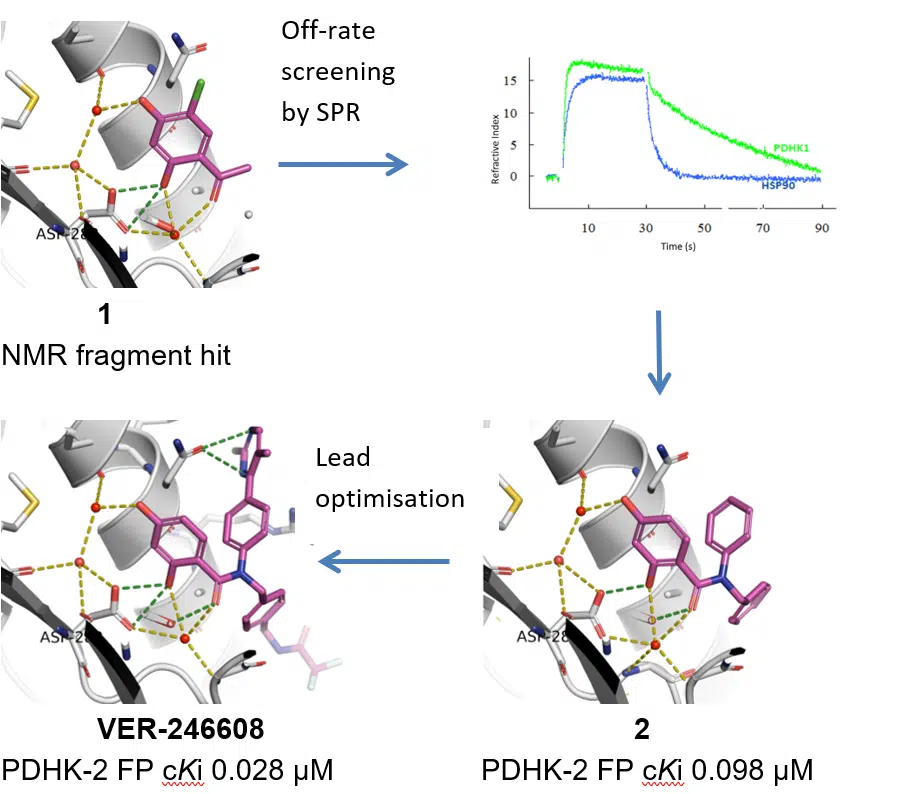
Off-rate screening of unpurified reaction products by SPR drove rapid hit-to-lead progression to selective, sub-100 nM pan-isoform PDHK inhibitors.
The Challenge
Hit-to-lead progression is usually gated by compound purification: every candidate has to be cleaned up before it can be measured, which caps how much chemical space a programme can sample. Vernalis pioneered off-rate screening to remove that constraint — measuring binding kinetics directly on unpurified reaction products. PDHK, a pan-isoform target requiring broad ATP-competitive coverage, was the test case.
Related Publications
Application of Off-Rate Screening in the Identification of Novel Pan-Isoform Inhibitors of Pyruvate Dehydrogenase Kinase
Brough, P. A. et al., J. Med. Chem. 2017, 60, 2271–2286
Read on ACS PublicationsVER-246608, a Novel Pan-Isoform ATP Competitive Inhibitor of Pyruvate Dehydrogenase Kinase, Disrupts Warburg Metabolism and Induces Context-Dependent Cytostasis in Cancer Cells
Moore, J. D. et al., Oncotarget 2014, 5, 12862–12876
Read on Impact JournalsOff-Rate Screening (ORS) by Surface Plasmon Resonance. An Efficient Method to Kinetically Sample Hit to Lead Chemical Space from Unpurified Reaction Products
Murray, J. B. et al., J. Med. Chem. 2014, 57, 2845–2850
Read on ACS PublicationsThe Science
Libraries of non-purified resorcinol amide derivatives were screened by surface plasmon resonance (SPR) to determine the binding dissociation constant (off-rate) for compounds binding to the pyruvate dehydrogenase kinase (PDHK) enzyme.
Parallel off-rate measurements against Hsp90, together with the application of structure-based drug design, enabled rapid hit-to-lead progression in a programme to identify pan-isoform ATP-competitive inhibitors of PDHK.
Lead optimisation identified selective, sub-100 nM inhibitors of the enzyme, such as VER-246808, which significantly reduced phosphorylation of the E1α subunit in the PC3 cancer cell line in vitro.
Crystal structure of an inhibitor bound to PDHK (PDB: 4V26).
Key Takeaways
- Screening unpurified reaction products removes compound purification from the critical path
- Parallel off-rate measurement against Hsp90 built selectivity into the cascade, not after it
- Selective, sub-100 nM pan-isoform inhibitors identified, including VER-246808
- Cellular target engagement confirmed by reduced E1a phosphorylation in PC3 cells
Service Areas
Work with us
Vernalis has collaborated with a wide range of partners to enable some of the most challenging therapeutic targets. Present and past collaborators include Servier, Pierre Fabre, Genentech and Lundbeck. Vernalis can support programs with DEL and fragment-based technologies through to establishing full drug discovery programmes for our partners.
Our track record is built on innovation and success in enabling drug discovery and identifying clinical candidates for a wide variety of therapeutic targets.
Research Director and Joint Site Lead
James Murray PhD

Similar Case Studies
Explore how our team overcomes challenges through case studies showcasing our success stories.
-
Hsp90 oral backup pre-clinical candidate
Fragment-based and in silico hits were combined into a novel series of Hsp90 inhibitors, delivering tumour growth regression on oral dosing in a BT474 xenograft model.
Outcome Oral pre-clinical candidate — the follow-on to the intravenous phase II compound. -
DYRK1A and DYRK1B selective inhibitors
A Vernalis and Servier NMR fragment screen delivered two series of potent, selective DYRK1A inhibitors, including the brain-penetrant tool compound 34.
Outcome Two optimised inhibitor series and a selective, brain-penetrant tool compound. -
Non-hydroxamate LpxC inhibitors
A Vernalis and Taisho collaboration used fragment and structure-based methods to deliver a non-hydroxamate LpxC inhibitor with antibacterial activity against P. aeruginosa.
Outcome Antibacterial lead that designs out the hydroxamate zinc-binding group and its selectivity risk. -
LRRK2 crystallographic surrogate
Vernalis engineered crystallographic surrogates of LRRK2 from Chk1 mutants, then used them to design a potent, brain-penetrant inhibitor with confirmed target engagement.
Outcome Target enablement — a crystallisable system, and a brain-penetrant inhibitor designed against it. -
Hsp90 phase II candidate
Fragment, virtual and medium-throughput screening produced NVP-AUY922, a well-tolerated Hsp90 inhibitor that progressed into global phase II trials.
Timeline Phase I entry 2007 to clinical proof of concept, April 2011.Outcome Clinical proof of concept, April 2011. -
Bcl-2 phase I clinical candidate
Structure-guided design produced S55746, an orally bioavailable and Bcl-2-selective inhibitor that spares platelets and reached phase I.
Outcome Phase I clinical candidate with a clean selectivity and tolerability profile. -
Mcl-1 in vivo active inhibitor
An NMR fragment screen and structure-guided design produced S63845, a specific, high-affinity Mcl-1 inhibitor with single-agent anti-tumour activity in vivo.
Outcome In vivo active inhibitor of a target long considered difficult to drug -
Chk1 pre-clinical application
Structure-guided fragment elaboration delivered V158411, a potent Chk1/Chk2 inhibitor that potentiates irinotecan without added systemic toxicity.
Outcome Pre-clinical candidate demonstrating combination efficacy without added toxicity.
Start your own success story
We’d love to hear from you! Head to our contact page to get started.