LRRK2 crystallographic surrogate
Where LRRK2 itself resisted crystallography, Vernalis engineered surrogates from Chk1 mutants and used them to design potent, brain-penetrant inhibitors.
The Challenge
Mutations in leucine-rich repeat kinase 2 (LRRK2), such as G2019S, are associated with an increased risk of developing Parkinson’s disease. Structure-based design against the LRRK2 kinase domain, however, requires structural information the target itself does not readily give up.
Related Publications
Design and Synthesis of Pyrrolo[2,3-d]pyrimidine-Derived Leucine-Rich Repeat Kinase 2 (LRRK2) Inhibitors Using a Checkpoint Kinase 1 (CHK1)-Derived Crystallographic Surrogate
Williamson, D. S. et al., J. Med. Chem. 2021, 64, 10312–10332
Read on ACS PublicationsDesign of Leucine-Rich Repeat Kinase 2 (LRRK2) Inhibitors Using a Crystallographic Surrogate Derived from Checkpoint Kinase 1 (Chk1)
Williamson, D. S. et al., J. Med. Chem. 2017, 60, 8945–8962
Read on ACS PublicationsThe Science
Surrogates for the LRRK2 kinase domain based on checkpoint kinase 1 (Chk1) mutants were designed, expressed in insect cells infected with baculovirus, purified and crystallised. The Chk1 10-point mutant was preferred, following assessment of surrogate binding affinity with LRRK2 inhibitors.
X-ray structures of the surrogates complexed with known LRRK2 inhibitors rationalised compound potency and selectivity.
Fragment hit-derived arylpyrrolo[2,3-b]pyridine LRRK2 inhibitors then underwent structure-guided optimisation using this crystallographic surrogate. LRRK2-pSer935 HEK293 IC50 data for compound 1 were consistent with binding to Ala2016 in LRRK2, equivalent to Ala147 in the Chk1 10-point mutant structure.
Compound 1 was shown to be potent, moderately selective, orally available and brain-penetrant in wild-type mice. Confirmation of target engagement was demonstrated, with LRRK2-pSer935 IC50 values for compound 1 in mouse brain and kidney being 1.3 and 5 nM respectively.
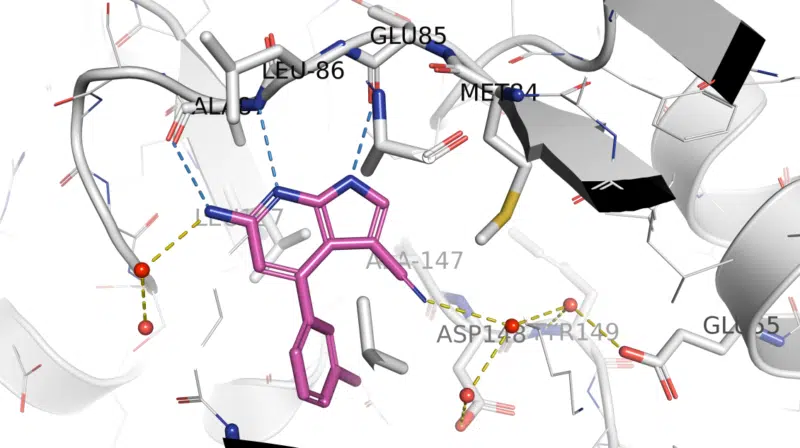
X-ray crystal structure of compound 1 with the Chk1 10-point mutant (PDB: 5OPU).
Key Takeaways
- A crystallisable surrogate built in-house where the target itself was intractable
- Surrogate designed, expressed in insect cells, purified and crystallised end to end at Vernalis
- Compound 1 potent, orally available and brain-penetrant in wild-type mice
- In vivo target engagement confirmed: LRRK2-pSer935 IC50 of 1.3 nM in brain, 5 nM in kidney
Service Areas
Work with us
Vernalis has collaborated with a wide range of partners to enable some of the most challenging therapeutic targets. Present and past collaborators include Servier, Pierre Fabre, Genentech and Lundbeck. Vernalis can support programs with DEL and fragment-based technologies through to establishing full drug discovery programmes for our partners.
Our track record is built on innovation and success in enabling drug discovery and identifying clinical candidates for a wide variety of therapeutic targets.
Research Director and Joint Site Lead
James Murray PhD

Similar Case Studies
Explore how our team overcomes challenges through case studies showcasing our success stories.
-
Hsp90 oral backup pre-clinical candidate
Fragment-based and in silico hits were combined into a novel series of Hsp90 inhibitors, delivering tumour growth regression on oral dosing in a BT474 xenograft model.
Outcome Oral pre-clinical candidate — the follow-on to the intravenous phase II compound. -
DYRK1A and DYRK1B selective inhibitors
A Vernalis and Servier NMR fragment screen delivered two series of potent, selective DYRK1A inhibitors, including the brain-penetrant tool compound 34.
Outcome Two optimised inhibitor series and a selective, brain-penetrant tool compound. -
Non-hydroxamate LpxC inhibitors
A Vernalis and Taisho collaboration used fragment and structure-based methods to deliver a non-hydroxamate LpxC inhibitor with antibacterial activity against P. aeruginosa.
Outcome Antibacterial lead that designs out the hydroxamate zinc-binding group and its selectivity risk. -
PDHK — application of off-rate screening
SPR off-rate screening of unpurified reaction products drove rapid hit-to-lead progression to selective, sub-100 nM pan-isoform PDHK inhibitors.
Outcome Proprietary off-rate screening validated on a live programme, delivering sub-100 nM leads. -
Hsp90 phase II candidate
Fragment, virtual and medium-throughput screening produced NVP-AUY922, a well-tolerated Hsp90 inhibitor that progressed into global phase II trials.
Timeline Phase I entry 2007 to clinical proof of concept, April 2011.Outcome Clinical proof of concept, April 2011. -
Bcl-2 phase I clinical candidate
Structure-guided design produced S55746, an orally bioavailable and Bcl-2-selective inhibitor that spares platelets and reached phase I.
Outcome Phase I clinical candidate with a clean selectivity and tolerability profile. -
Mcl-1 in vivo active inhibitor
An NMR fragment screen and structure-guided design produced S63845, a specific, high-affinity Mcl-1 inhibitor with single-agent anti-tumour activity in vivo.
Outcome In vivo active inhibitor of a target long considered difficult to drug -
Chk1 pre-clinical application
Structure-guided fragment elaboration delivered V158411, a potent Chk1/Chk2 inhibitor that potentiates irinotecan without added systemic toxicity.
Outcome Pre-clinical candidate demonstrating combination efficacy without added toxicity.
Start your own success story
We’d love to hear from you! Head to our contact page to get started.